
Utah State Prison Release Path
Utah State Correctional Facility is operated by the Utah Department of Corrections in Salt Lake City. It is outside Millard County, yet it can receive a person sentenced in a Millard County felony case. A sentencing court imposes the prison term. The Utah Board of Pardons and Parole then makes release decisions within Utah's indeterminate sentencing framework, while UDC maintains custody and later supervises parole.
A parole order with a future effective date is not proof that
the person has left prison. Utah Code allows the Board to
rescind a date before physical release. Once the date passes,
the public UDC record should be checked for
Location: PAROLE. That location is evidence of
present community supervision. An expiration or termination
result is different and may require the Board's decision history
or a UDC records request.
| Source | What it establishes |
|---|---|
| Sentencing docket | The court's commitment and sentence |
| Board order | The release decision and effective date |
| UDC Location | Prison placement, county placement, parole, or probation |
| VINE event | An agency-reported release or movement alert requiring verification |
Utah State Correctional Facility Date Sequence
A Millard sentence can generate several dates before a person
leaves Utah State Correctional Facility. The Board calendar may
first show a tentative or actual hearing date. A later decision
has its own decision date and may set an effective parole date.
UDC can then display that future date in the field labeled
Release Date/Type. None of those calendar entries
is the completed physical release time. The ordered date remains
subject to rescission until release occurs.
Review the sequence in order. First, identify the sentencing
case and offender number. Next, locate the Board decision and
read its exact description, effective date, and any attached
order. After the effective date, search UDC again. A result
showing Location: PAROLE and no prison housing
facility supports community release under supervision. If the
person still has a prison or county placement, check for a later
Board action, an unmet contingency, or a movement record before
drawing a conclusion.
Utah uses indeterminate prison sentences, so a court-imposed
range does not supply one automatic release day. The Board
considers the sentence and makes an individual decision within
its authority. Earned-time credit can affect an existing date
for an eligible person, but program completion alone does not
prove the credit was applied. Preserve the Board order when
found because a later community result may show
Release Date/Type: N/A, and a fully discharged
person may eventually leave the current-supervision search.
Search Utah State Prison Releases
The UDC Offender Search is the correct public locator for a person under Utah corrections supervision. It is not a county roster. It excludes ordinary unsentenced people held in Millard County Jail and does not serve as a permanent archive of everyone once supervised by UDC.
- Choose a name search or enter the UDC offender number.
- For a name query, enter at least one character in both first and last name. Middle name is optional.
- Compare the offender number, full name, and date of birth before opening details.
-
Read Location, Housing Facility, and the exact field labeled
Release Date/Type. -
After an ordered date, look again for
Location: PAROLEand compare the Board order.
A future entry ending in Parole date is a scheduled
event. Some records show N/A. Once a person is on
parole, Housing Facility may show N/A because the
person is no longer housed in prison. A fully discharged person
may disappear from the public search because UDC limits it to
current supervision.
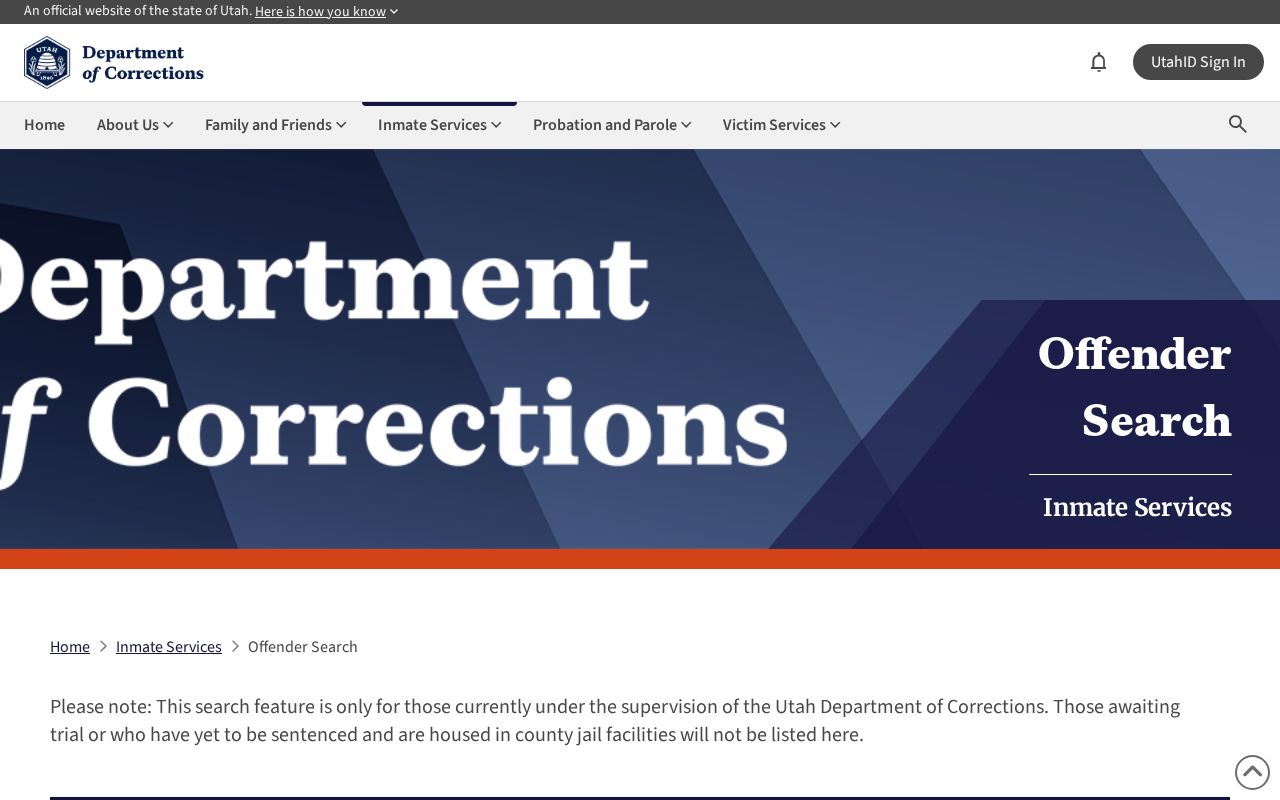
The official search image demonstrates the UDC name and number route:
Utah State Prison Board Records
The Board's Search Hearings and Decisions accepts first and last name, optional middle name, offender number, or a date range. Date searches span no more than seven calendar days. Person results can include hearing dates, decision dates, descriptions, effective dates, and downloadable orders.
Read the exact result. PAROLE GRANTED,
PAROLE DATE ADJUSTED, PAROLE REVOKED,
sentence termination, sentence expiration, warrant issuance, and
rescission have different meanings. A hearing calendar entry
means only that a hearing is scheduled.
Decision Pending is not a release order. Even a
granted future date can change before the person walks out.
Important: The durable confirmation chain is a dated Board order followed by a UDC community location after the effective date.
Utah State Prison Movement Alerts
Utah VINE adds notifications, but an alert must be interpreted by event type. UDC lists prison release, escape and return, death, a parole-release-date notice before release, moves to county jails, moves between Utah's Salt Lake City and Gunnison prison sites, and moves to community correctional centers. Several of those are transfers, not freedom.
Search the Utah portal by name or offender number, verify the reporting facility, and compare identifiers. A VINE release message reports what the source agency supplied. It does not decide the court case or prove that no other authority holds the person. Technical issues can also affect notices, so verify an important status through UDC or the Board.
Note: A change from Utah State Correctional Facility to another housing site is movement inside the corrections system unless a parole or discharge record says otherwise.
Utah State Prison Parole Status
UDC Adult Probation and Parole supervises a person after prison release to parole. The Board makes the release decision; AP&P carries out supervision. Millard County is served by Region 4 from Richfield, not by an office listed inside the county.
UDC Adult Probation and Parole, Region 4835 East 300 North, #500
Richfield, UT 84701
435-896-2770
Search the UDC record and Board order before calling. The
regional office can help with status clarification or routing
when public fields are ambiguous, subject to disclosure limits.
A PROBATION location means court-ordered community
supervision, not parole from Utah State Correctional Facility. A
warrant entry records an enforcement step but does not alone
prove that the person has been taken back into custody.
Utah State Prison Release Records
Board orders are often the fastest documentary source. When the public search is incomplete, request a release or discharge record from UDC. Identify the person's full name, offender number, and the specific commitment, movement, release, parole, expiration, or termination record sought. A focused request is easier to route and less likely to mix people with similar names.
Utah GRAMA distinguishes public material from private, controlled, and protected information. Medical, security, victim, and other restricted details may be withheld even when a release event is public. Ask for all reasonably separable public fields and request the classification and statute for any denial.
Specify whether the goal is the Board's ordered date, the actual movement from secure custody, the start of parole, or the final discharge. These are separate records. Include a narrow date range and ask for electronic copies when available. If the response omits a field, ask whether the agency does not maintain it or classified it as nonpublic. That distinction matters when building an accurate timeline.
- Parole
- Conditional prison release into UDC community supervision.
- Discharge
- The end of the relevant corrections obligation, unlike a move to parole.
- Rescission
- Withdrawal of a previously ordered future release date before release.
- Transfer
- A change in physical placement while legal custody continues.
Millard Cases at Utah State Prison
A Millard County court case can lead to commitment at a state prison even though neither Utah State Correctional Facility nor Central Utah Correctional Facility sits inside the county. Placement may also change over time. The housing facility answers where the person is assigned now. It does not replace the Board's release order.
Millard County Jail also houses some UDC prisoners by contract. A person may therefore move from the Salt Lake City prison to Fillmore and still remain in state custody. For a broader distinction between local jail release records and state corrections records, use the Millard County Jail release page. The key question is always which agency held legal custody at the moment being researched.
The Millard sentencing docket remains useful after prison placement changes. It identifies the commitment and case number that connect the person to the state sentence. Later Board records show release decisions, while UDC shows current supervision. These sources answer different parts of the same history. A prison housing change should never be used as a substitute for a release order.