
Millard County's Missing Release Feed
The official sweep found no working Millard County roster, booking archive, or rolling list of releases. The Millard County Sheriff's website currently shows a maintenance page. The county's stable sheriff page gives contact information, but it does not provide a 24-hour view. No official source states the feed's fields, refresh rate, photo status, or retention period because no such feed could be verified.
This gap changes the same-day search. A missing name cannot prove release. It may reflect site downtime, a spelling difference, a transfer, a state contract placement, or a record that never appeared online. Commercial lists cannot fill that proof gap. Their update claims were not verified against a live Millard source.
No online result is a substitute for the jail's actual release date, time, type, and receiving authority.
Check Millard County Same-Day Releases
Start with the custody event, not a guessed online list. The official county sheriff page identifies the jail and its phone line. Have enough detail to distinguish the correct booking, especially when a person has a common name or more than one case.
- Write down the full legal name, date of birth, and approximate booking date. Include a booking number if it is known.
- Call the Millard County Jail at 435-743-5302. Ask whether the person is held now and whether the named booking ended during the target 24-hour period.
- Ask for the actual release date and time, the recorded release type, and the destination or receiving agency.
- If staff cannot provide the fields, send a narrow GRAMA request to the sheriff as the record holder.
- Match the answer to the court, UDC, BOP, or ICE system named by the release type or receiving agency.
The full named-person path and the release-record fields are covered on the Millard County released inmate search. A phone answer such as “not here” is only a starting point. Ask whether the last event was release to the community or a transfer.
Millard County Release Record Fields
Because Millard County publishes no verified 24-hour table, the useful fields below are request targets, not promised online columns. They tie a person to one custody episode and show what happened at the end of that episode.
| Requested field | What it establishes |
|---|---|
| Full name and booking number | Which person and custody episode the record concerns. |
| Booking date and time | When the specific jail event began. |
| Actual release date and time | When Millard County relinquished custody. |
| Release type or code | Whether the event involved bond, time served, a court order, transfer, or another disposition. |
| Receiving agency or destination | Whether the person returned to the community or entered another custodian's control. |
| Charges and case numbers | Which court docket may contain the legal order behind the event. |
Property-release notes, release authorization, and a booking photograph may sit in separate parts of the file. GRAMA can also permit redaction of protected information, so request the reasonably segregable public portion if the full record cannot be released.
Request Millard County Release Records
Millard County's GRAMA instructions direct a requester to send the state form to the office that keeps the record. For jail release data, address the request to the Sheriff's Office/Jail at 765 South Highway 99, Fillmore, UT 84631. Describe one person, one booking, and a narrow date range. Ask for electronic copies and an advance fee estimate.
Utah Code § 63G-2-204 requires a written request with contact information and a reasonably specific record description. The ordinary statutory response structure is ten business days, while a qualifying public-benefit expedited request can use a five-business-day path. Extraordinary circumstances can extend those periods. Utah Code § 63G-2-203 permits reasonable actual-cost fees, and Millard has not published a sheriff-specific release-record fee table in the sources reviewed.
A useful written request asks for the releasable booking and custody record, actual release timestamp, release code, receiving agency, associated charge and case numbers, and public release authorization. It should ask for any reasonably segregable public fields when part of the file is withheld. If access is denied, request the record's GRAMA classification and the exact statutory basis. That written decision supplies the starting point for the administrative appeal path and avoids treating a limited phone disclosure as the entire record.
If a three-day span would better capture weekend processing, the Millard County 72-hour release route explains how to define that wider request.
Read Millard County Release Types
A release from the county booking ledger does not always mean freedom from confinement. Bond, recognizance, time served, or a court-directed community release may end the jail stay. A transfer to UDC, USMS, ICE, another county, or another jail ends Millard's custody but starts or continues a different custody event.
- Bond or recognizance
- Release while the court case may continue.
- Time served
- Completion or credit applied to the confinement at issue.
- Transfer
- Movement to another legal custodian, not community release.
- Parole
- Conditional release from a state prison sentence into UDC supervision.
- Probation
- A community sentence ordered by a court, sometimes after a jail term.
Millard County Jail also houses UDC contract prisoners. For a state prisoner, confirm a Board order and check whether UDC changes the person's Location to `PAROLE`. For a local detainee, use the jail timestamp and court docket. The system that held legal custody determines which proof matters.
A Board order with a future effective date is not the same as physical release. Utah law allows the Board to rescind a prison release date before the person leaves custody. Wait until the date passes, then compare the order with the UDC Location. A result showing `PAROLE` supports community supervision; a named jail or prison indicates continued placement. For a federal handoff, a past BOP release date applies only to BOP custody. An ICE result has its own custody meaning and shorter public released-person window.
Why Millard Releases Cannot Be Assumed
The maintenance page is the distinctive local data issue. It means no official rolling window can be tested for event time, calendar-day cutoffs, late entries, or photo retention. It also means a commercial “no inmate” message has no official Millard feed against which it can be validated. Direct jail confirmation plus a date-bounded GRAMA request is the sound path.
The evidence should answer four separate questions: who left this custodian, when did the event occur, what release type was entered, and who received the person. Those details protect against a common mistake. A person transferred to UDC, ICE, USMS, or another county has left Millard County's ledger but may remain confined.
The available sheriff maintenance screen shows the online limitation:
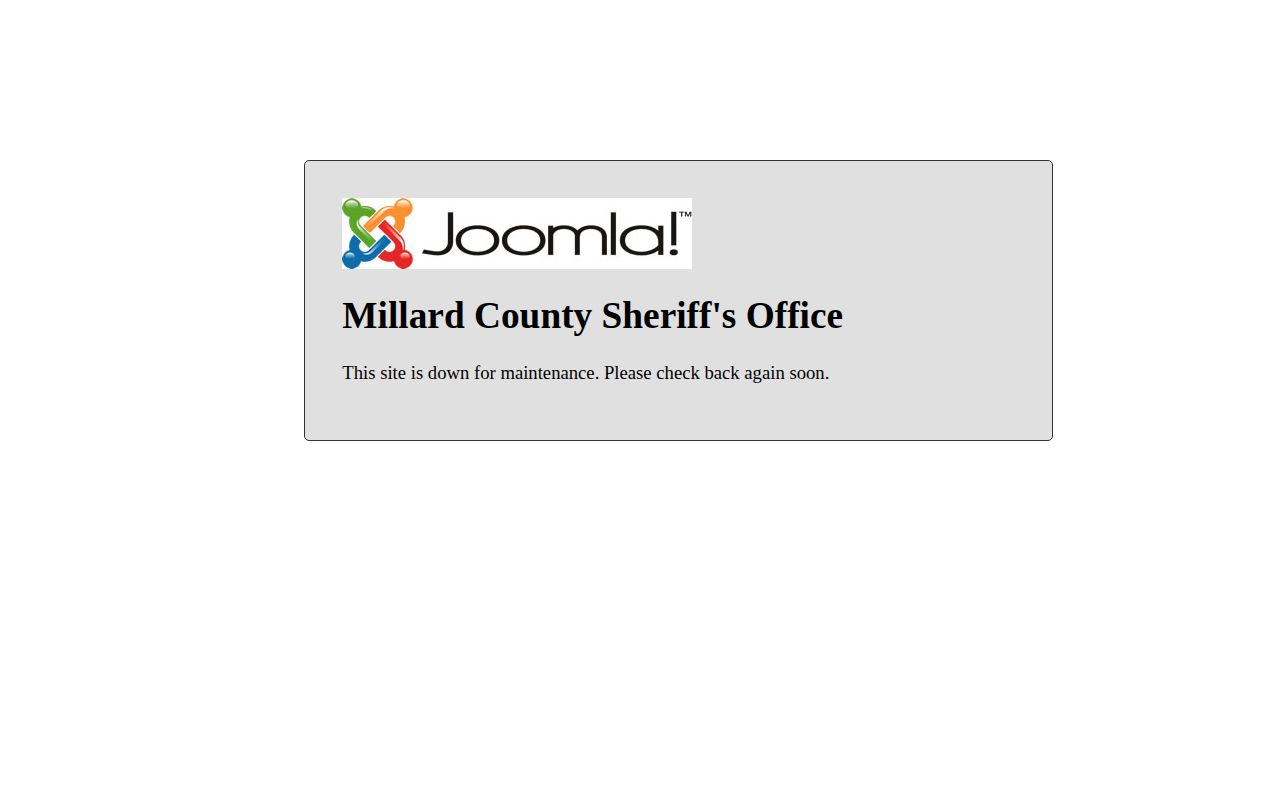
The screen supports using the county's stable contact and records channels until an official release feed returns and can be verified.
Supplement Millard County Release Proof
Utah VINE can add a custody-change notice when a live result shows Millard as the reporting agency. The state sources did not expose a county-by-county participation list, so coverage must be confirmed from the record itself. A VINE “released” status means that reporting agency closed or changed its custody event. It does not prove that every case ended or that no other authority holds the person.
The Utah Department of Corrections Offender Search is the right follow-up for a state-sentenced person or a contracted UDC prisoner. It covers people currently under UDC supervision, including records whose Location reads `PAROLE` or `PROBATION`. It does not cover ordinary unsentenced county detainees and is not a permanent archive of fully discharged people.
VINE registration may help with a future change. Utah's published service supports telephone and email, with text or app channels where offered on the live record. A telephone registration uses a PIN chosen or requested during setup. No reviewed Utah source establishes a fixed PIN length. UDC describes repeated calls until confirmation under its published retry schedule, but a delayed or missed alert remains possible. The Utah Board has also warned that technical issues can produce inaccurate or missing VINELink notices.
For the legal reason behind a local release, search Utah Xchange in the correct district or justice court. A release order or dismissal can explain authority, yet the jail record remains the source for the actual processing time. Federal and immigration transfers require BOP, PACER/USMS, or ICE follow-up based on the receiving authority.
Millard's court split matters during that check. Felonies and class A misdemeanors are handled in Fourth District Court in Fillmore. Most class B and C misdemeanors, infractions, and local ordinances run through justice court, with East Justice Court in Fillmore and West Justice Court in Delta. When the charge level is unknown, search both court tiers. A court disposition can outlast an online custody display, but expunged, sealed, juvenile, nonpublic, and some older cases do not appear in public Xchange.
Note: A court order can authorize release before the jail completes identification, property, hold, and transport checks.