
Federal Utah Release Systems
No federal prison was identified inside Millard County. Federal custody can still affect a local booking. A person may be transferred from Millard County Jail to the U.S. Marshals Service while a federal case is pending. After federal sentencing and commitment, BOP becomes the main prison-record system. Immigration custody is separate and should be checked through ICE, not inferred from a federal criminal result.
The distinction changes where release is visible. BOP offers a public person-level locator with a release date and custody label. USMS has no equivalent public release locator. A federal pretrial release is usually confirmed through the District of Utah docket in PACER and, when needed, a custody inquiry to USMS. A Millard record marked transfer to either agency does not prove release to the community.
| Federal stage | Primary record | What it can show |
|---|---|---|
| Pretrial or court-ordered detention | PACER and District of Utah docket | Detention, bond, release, acquittal, or commitment orders |
| USMS physical custody | USMS inquiry plus court docket | Custody clarification, subject to disclosure limits |
| BOP committed sentence | BOP Inmate Locator | Location, release date, or not-in-custody status |
| Post-release federal supervision | Federal court and supervising agency records | Supervised-release terms and later orders |
Federal Custody Serving Utah Timeline
A federal timeline tied to Millard County should begin with the county's receiving-agency field. When it names USMS, search the District of Utah docket for the detention or release order that governed the federal pretrial stage. When it names BOP, use the federal identifier in the BOP locator to find the committed sentence record. Keep the county release time separate from the later federal release date because the first marks a handoff and the second marks the end of BOP custody.
PACER entries can show an initial detention decision, later bond conditions, acquittal, dismissal, sentencing, or commitment. Those legal events do not always state the exact hour that USMS completed physical processing. USMS has no public released-person locator, so an unclear pretrial status may require a focused inquiry using the case number and exact name. A blank BOP search cannot settle that issue because a federal defendant may remain in USMS custody without ever becoming a committed BOP prisoner.
After commitment, BOP's result supplies a more durable public
trail. Read Release Date and Location together. A past date with
no facility, or a result marked RELEASED or
Not in BOP Custody, confirms departure from BOP
custody under the agency's own explanation. It does not end
federal supervised release or rule out a Utah, Millard County,
or ICE hold. For records before the locator's main 1982-forward
coverage, use the National Archives route with identifying
details and approximate custody dates.
BOP Federal Release Lookup
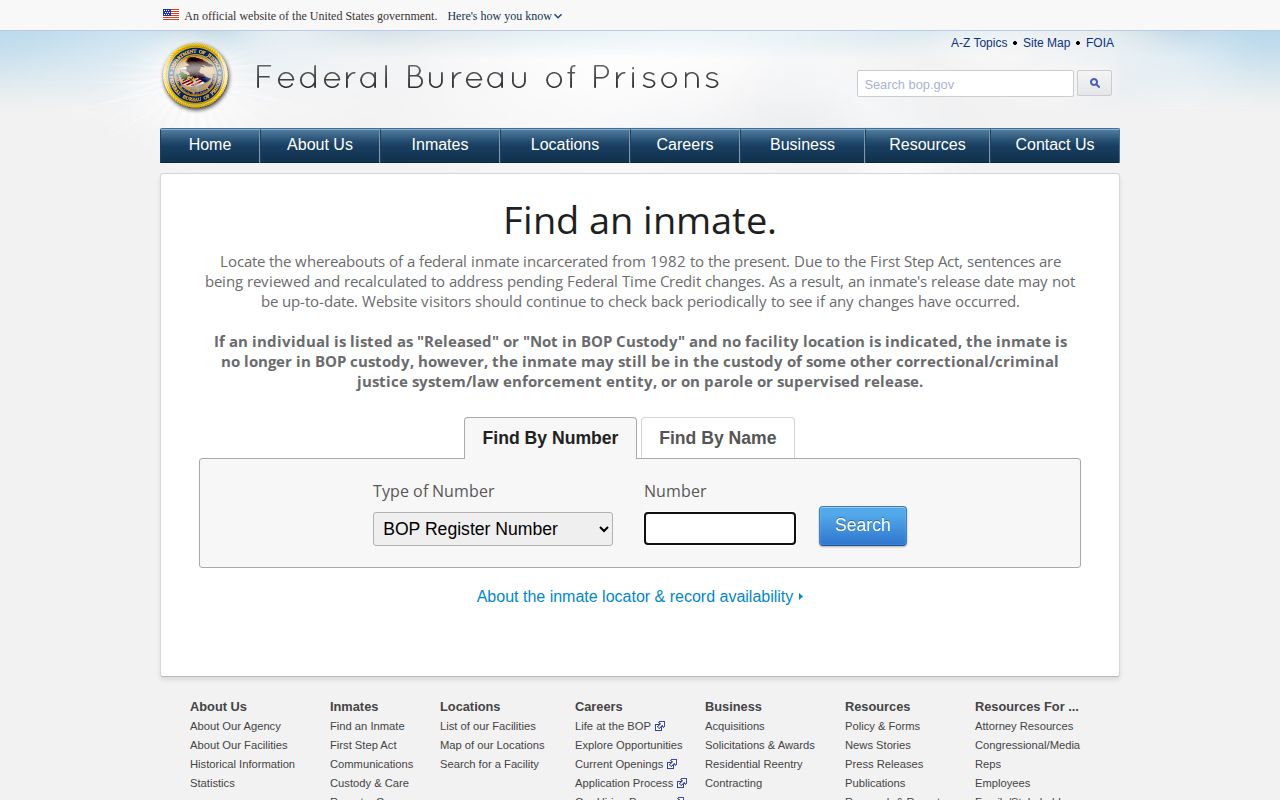
The BOP Inmate Locator covers federal incarceration records mainly from 1982 forward. Search by BOP register number, DCDC number, FBI number, INS number, or name. Name searches may be refined with middle name, race, age, and sex. Results list the person's name, register number, age, race, sex, release date, and location.
- Use a federal identifier when available because it reduces same-name errors.
- Otherwise enter the legal name and only supported refinements.
- Compare the register number and identifying details in the result.
- Read both the Release Date and Location fields.
-
If the person is no longer shown at a BOP site, check whether
the result says
RELEASEDorNot in BOP Custody.
BOP's own explanation gives those terms a precise meaning. A past release date with no facility, or a not-in-custody label, means the person left BOP custody. It does not rule out state, county, immigration, or another federal custody episode. Nor does it mean a term of federal supervised release has ended.
The official BOP locator image shows the federal person-search route:
Federal BOP Release Dates
A past BOP release date can confirm the end of that BOP custody term. A future date is projected and may change. BOP notes that calculations can be revised, including through First Step Act time-credit work. The locator is reported as updated daily, so it can still lag a very recent operational change.
For older federal custody before the main online period, BOP directs record seekers toward the National Archives. A useful historical request includes the full name, date of birth or approximate age, race, and approximate custody dates. For more detail about a BOP term, use the agency's Freedom of Information Act records route.
Important: Not in BOP custody means only that BOP custody ended. Check the court and any named receiving authority before concluding the person returned home.
USMS Utah Pretrial Releases
The U.S. Marshals Service is responsible for federal court-ordered detainees from detention through acquittal or delivery to BOP. It can use state and local holding facilities. A person connected to Millard County may therefore be in federal pretrial custody without appearing as a committed prisoner in the BOP locator.
The public release path is the federal case docket. Search PACER for the District of Utah case and read detention orders, bond conditions, release orders, plea and sentencing entries, acquittal, dismissal, or commitment to BOP. A court order explains legal authority. It may not give the exact time when physical processing finished.
USMS publishes no public person-level release search that matches BOP's locator. If the docket leaves the current custody result unclear, contact the District of Utah USMS for official routing or status clarification. Staff may limit disclosure. Provide the federal case number and exact name, and do not ask a county jail to interpret a later federal event.
Millard Federal Transfer Records
A Millard County Jail record should identify the receiving authority when available. If it says USMS, the person left county custody but entered or continued federal custody. If it says BOP, use the locator for the committed prison record. If the destination is vague, request the release type, actual time, destination, and transfer authority from the sheriff's records custodian.
Pair the local event with the federal record. The county timestamp shows when Millard relinquished custody. The PACER docket shows the federal legal basis. A later BOP result shows committed custody and its end date. Keeping those layers separate prevents a transfer from being mislabeled as a community release.
- Committed custody
- Federal imprisonment administered by BOP after commitment.
- Pretrial detention
- Custody tied to a pending federal court case, commonly managed by USMS.
- Supervised release
- A federal community-supervision term that can follow imprisonment.
- Detainer
- A request or legal basis for another authority to take custody.
Federal Utah Release Records
Use the shortest official route that matches the record. BOP Locator answers basic committed-custody status. BOP's FOIA process can supply additional agency records. PACER supplies the court's orders and docket history. USMS can address its own custody when the public docket is not enough, but no public USMS locator exists.
A focused request should name the person, federal identifier or case number, approximate dates, and the exact release, transfer, designation, or commitment document sought. Older BOP records may require the National Archives. A no-match in BOP does not prove no federal case because pretrial USMS custody and older records fall outside the locator's main role.
For the local side, the Millard County release record search explains the jail and court chain. Ask Millard County Jail whether the person went to the community or to a receiving agency before choosing a federal tool.
Federal Utah Custody Boundaries
Federal criminal custody and immigration custody can touch the same person but remain distinct. An INS number may be accepted as a BOP search identifier, yet that does not turn the BOP result into an ICE record. If a county or federal record names ICE as the receiving authority, use ICE's Online Detainee Locator promptly and follow its own limits.
State custody is also separate. A UDC prisoner transferred from a county placement remains in Utah corrections even if a federal detainer exists. Likewise, a BOP release date does not resolve a pending Utah hold. The receiving-agency field, court dockets, and current locators must be read in sequence.
Note: One person's timeline can contain county, USMS, BOP, and ICE events, but each event ends only the custody episode shown by its source.
Federal Utah Release Contacts
There is no local building contact because the Facility Map identifies a federal system serving Utah, not an in-county federal prison. Use BOP's locator and records pages for committed prisoners. Use PACER and the District of Utah USMS for pretrial matters. Names, case numbers, register numbers, and dates should be confirmed before making contact.
Federal Custody Serving UtahBOP for committed imprisonment
USMS and District of Utah docket for pretrial custody
No federal prison identified in Millard County
Online records should be preserved with the access date when timing matters. Federal case entries and projected dates can change. An official record from one system should not be extended beyond what that agency actually reports.