
Millard County 72-Hour Release Status
No official rolling Millard County 72-hour release feed was found during the research sweep. There is no verified release-list URL, stated three-day window, published field inventory, update cadence, retention period, or photo column. The sheriff domain directs visitors to a maintenance page, while the stable county sheriff page supplies contact details but no inmate search.
This absence changes the task. A name missing from an unofficial roster is not proof of release. A result from another Utah county also says nothing about Millard County Jail. The useful question is whether a named custody event ended during a defined three-day period, why it ended, and whether another authority received the person.
Request Millard Three-Day Releases
A three-day request should state exact beginning and ending times. Calendar language such as “over the weekend” can be unclear, especially when staff process a release near midnight. A precise request may ask for the releasable release log from 12:00 a.m. on the first date through 11:59 p.m. on the third date. Ask for protected fields to be redacted rather than requesting the whole record be withheld.
- Choose the exact three calendar dates and record the local start and end times.
- Contact Millard County Jail at 435-743-5302 and ask whether a release log can be produced for that range.
- Request actual release date and time, release type, and receiving agency for each releasable event.
- Use the Utah GRAMA request form when a written request is required.
- Ask for electronic records, an advance fee estimate, and the legal classification of any withheld field.
Whether an aggregate log exists, which fields are public, and what fee applies remain decisions for the Millard County records custodian. Do not assume a spreadsheet or a no-cost response. Utah Code § 63G-2-204 supplies the request procedure, while § 63G-2-203 permits qualifying actual-cost fees and sets waiver rules.
Note: A date-bounded request is wider than a named-person inquiry and may require more staff search time.
Millard 72-Hour Release Record Fields
Because there is no public feed, none of these fields can be described as a current online column. They are the fields to request from the custody record. Each one answers a different part of the three-day question. The booking number prevents confusion when the same person has more than one custody episode.
| Requested field | What it establishes |
|---|---|
| Full name and booking number | The person and exact Millard County custody event |
| Booking date and time | When that custody episode began |
| Actual release date and time | Whether the event falls inside the defined three-day range |
| Release type or code | Bond, time served, court order, transfer, or another recorded outcome |
| Receiving agency | Whether the person entered UDC, USMS, ICE, another county, or another custodian |
| Case number and authority | The court matter and order connected to release |
No official photo field was verified. Do not infer that a booking image accompanies an aggregate log. Property notation, bond information, the release authorization, and a booking photograph may exist in related records, but each may need to be named in a separate focused request.
Millard Weekend Release Catch-Up
A 72-hour range is most useful when a one-day check would split a weekend or holiday period. Set the range before contacting the jail. For example, a calendar-day request should state each date and time boundary rather than relying on “last three days,” which changes as the request is read or processed. This keeps the requested period stable.
Administrative timing also matters. A court order can authorize release before Millard County Jail completes its custody process. The docket time is not automatically the actual release time. A late event may be entered after the moment the person leaves, and the research found no official update schedule that would let a reader predict when a public entry should appear.
The wider range catches more events, but it does not make the evidence stronger by itself. Match every listed release to its type and destination. For a same-day focus, the Millard jail releases in 24 hours page uses a narrower request window.
Millard Release Roster Maintenance Gap
The Millard County Sheriff maintenance page documents why an official three-day roster cannot be inspected now.
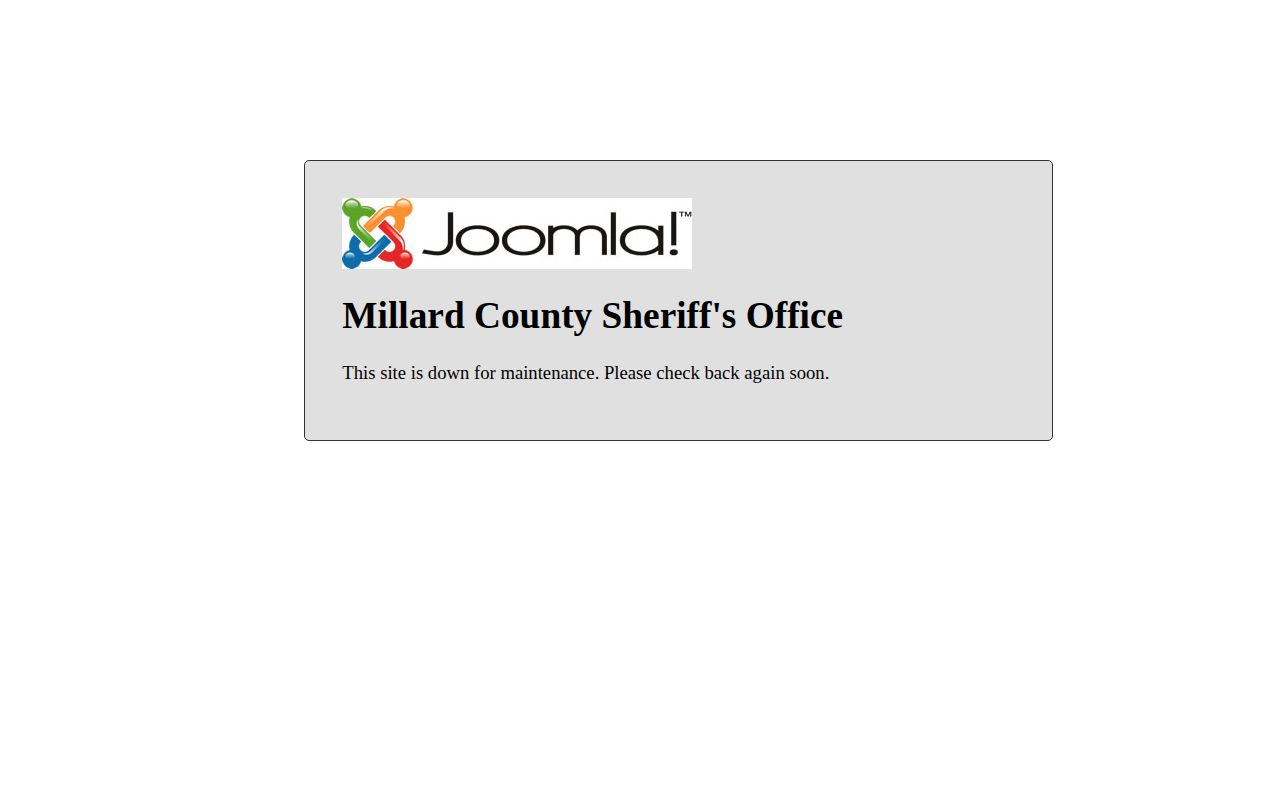
The captured page supports only the maintenance finding. It does not prove that no one was released, that a private roster is correct, or that the sheriff will later publish a 72-hour view.
If the sheriff service returns, the official site should be checked again for current inmates, releases, booking history, individual booking pages, and specific 24-hour, 48-hour, or 72-hour filters. Any live feed would need a new review of its timestamp, rolling-window logic, fields, photo display, and retention before those features could be stated.
Missing Millard Release Names Prove Nothing
Millard's lack of a reachable official roster or recent-release archive is the key local data issue. A commercial “no inmate” result cannot establish that a person left custody during the target three days. It may reflect stale data, incomplete coverage, a mismatched name, or a system that never had the Millard event.
The reliable response is direct jail confirmation plus a date-bounded GRAMA request. Ask four separate questions: is the person currently held, what actual release time applies to the named booking, what release type was entered, and whether the destination was the community or another authority. Those answers route the next check.
Note: “Not here” is current-location information, not a full account of the prior custody event.
Millard Releases Versus Custody Transfers
Millard County Jail holds local detainees and some contracted UDC prisoners. An entry that ends the Millard custody ledger may therefore describe several different outcomes. Bond, recognizance, time served, or a court release may return a local detainee to the community. A transfer to UDC, USMS, ICE, another jail, or another prison does not.
| Three-day result | What to check next | Community release? |
|---|---|---|
| Bond or recognizance | Jail record and court docket | Usually from that jail, while the case continues |
| Time served or court order | Actual jail time and the controlling order | Possible, unless another hold applies |
| UDC transfer | UDC Location and Housing Facility | No |
| USMS or ICE transfer | Federal docket, BOP, USMS, or ICE as applicable | No |
| Parole | Board effective date and UDC `PAROLE` status | Conditional state release |
Destination is essential. A contracted state prisoner can leave the Fillmore building for another UDC placement without leaving state custody. Likewise, a local release to ICE ends the county event while immigration custody begins or continues.
Millard Aggregate Release Log Requests
An aggregate three-day log differs from one person's release record. It asks the custodian to identify releasable events across a fixed period, which can require a broader database or file search. State the fields needed and allow protected content to be redacted. Do not demand a format that the jail may not maintain.
A named-person request can be more precise when identity is already known. It can include the booking number, date of birth, charges tied to that booking, release authority, and destination. The aggregate request is better for a complete weekend catch-up, while the individual record is stronger for proving what happened to one person.
Note: GRAMA governs access to existing records and does not guarantee that the jail maintains a custom three-day report.
Verify Millard Three-Day Release Results
The court docket explains why local custody was supposed to change. Search Utah Xchange by case number when known, or by name with Millard County, court, case type, and date refinements. District court handles felonies and class A misdemeanors. Justice court handles most class B and C misdemeanors, infractions, ordinances, and traffic matters. A disposition still does not provide the physical jail timestamp.
For a UDC prisoner, use the UDC Offender Search. It covers current state supervision and can show `Location: PAROLE` or `PROBATION`; it does not serve as Millard's pretrial roster or a permanent discharge archive. For parole, pair UDC status with the Board's dated order.
Utah VINE can supplement the result when a live record shows the relevant reporting agency. A release or movement notice means that agency changed or ended its custody event. It does not prove dismissal, completion of all legal obligations, or freedom from another authority. Confirm the message with the jail, UDC, Board, or court.
Limits of Millard 72-Hour Records
The research established several unknowns. Millard County has no verified online three-day feed, cadence, retention duration, booking-photo display, or official sheriff mobile app. Generic jail apps do not prove local participation. A future app should be accepted only when the county or sheriff links it, or when its agency directory and a live Millard entry can be confirmed.
A three-day log is also not a current-custody roster. It records departures from a custodian during a set range. Someone released early in the period may later be booked again. Another person may leave Millard and enter state or federal custody. The actual release record, destination, and later system status must be read together.
For one named person rather than an aggregate window, the Millard County released inmate search follows county, state, court, VINE, and federal channels. That route is better when identity and custody history matter more than a list of everyone who left during three days.
Note: Recheck the official sheriff service before relying on any future claim about feed access, cadence, retention, photos, or apps.